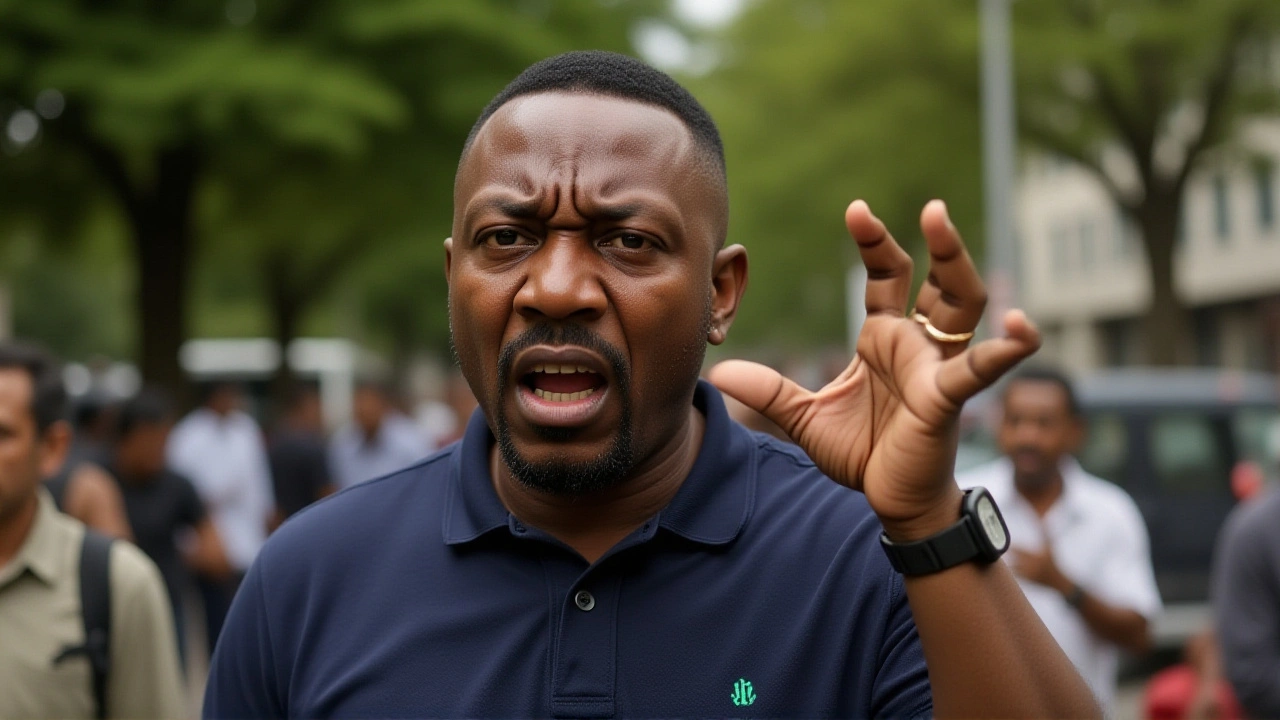
When Omoyele Sowore, a veteran human‑rights activist and former presidential hopeful, marched onto the streets of Abuja on October 20‑21, 2025, he did so with a single chant pulsing through the crowd: "Free Nnamdi Kanu now". The rally, officially dubbed the Free Nnamdi Kanu protestAbuja, was organized despite a court order barring any public demonstration and a direct warning from the Nigerian Police. Within hours, six convergence points across the capital swelled with thousands of demonstrators, each chanting in unison while police rain‑coated the streets with tear‑gas canisters and, eventually, live rounds.
Why Nnamdi Kanu Remains a Flashpoint
The man at the heart of the protest, Nnamdi Kanu, is the leader of the Indigenous People of Biafra (IPOB), a movement that has been deemed illegal by the Nigerian government since 2017. Kanu’s 2015 arrest on charges of treason sparked a series of confrontations between Biafran separatists and federal forces, leaving a deep scar on Nigeria’s southeast. While his supporters argue he is a political prisoner, the state contends that his rhetoric incites secessionist violence. The latest court decision—delaying his trial indefinitely—has inflamed an already volatile situation, turning Kanu into a rallying point for broader grievances about perceived government overreach.
How the Protest Unfolded
Sowore’s strategy was meticulously choreographed. He announced the march on his Twitter feed on October 14, inviting participants to gather at six strategic locations: the Unity Square, the National Assembly grounds, the University of Abuja campus, the Ministry of Interior, the Abuja Airport perimeter, and the Central Business District. Each site was chosen to maximize visibility while keeping the protest decentralized, a tactic meant to avoid a single‑point police crackdown.
- October 20, 09:00 GMT – Unity Square: ~1,200 demonstrators
- October 20, 11:30 GMT – National Assembly: ~1,800 participants
- October 20, 14:00 GMT – University of Abuja: ~1,400 students
- October 20, 16:30 GMT – Ministry of Interior: ~1,100 citizens
- October 21, 08:45 GMT – Abuja Airport perimeter: ~900 travelers
- October 21, 11:15 GMT – CBD: ~2,000 office workers
According to Sowore, the gatherings were “orderly, peaceful, and well‑conducted,” with volunteers handing out water and first‑aid kits. No banners displayed weapons; the only visual was a sea of white shirts bearing the slogan “Free Kanu.”
Police Reaction: From Tear Gas to Gunfire
At roughly 12:20 GMT on the first day, police units in riot gear began deploying tear‑gas canisters around Unity Square. By the time the first volleys of smoke drifted through the crowd, the police had also set up steel‑barricades, effectively cutting off any escape route. Witnesses say the situation escalated when officers, allegedly under orders from a senior commander, opened fire on unarmed demonstrators, injuring at least eight people, three of them with gunshot wounds that required hospitalisation.
In a televised interview on Arise Television later that evening, Sowore condemned the response: “There was no provocation on our part; it was orderly and peaceful; it was an unprovoked attack from the police force and a combined team of security operatives.” He added that the same forces “tolerate terrorists and bandits walking around Abuja with ammunition, yet they turn their guns on peaceful citizens.”
The police released a statement the following morning, arguing that the use of force was justified because “thirteen people had been detained earlier during the protest,” implying that the earlier arrests were a legitimate pre‑emptive measure. However, no video evidence of the alleged detentions has been publicly released, and legal experts are questioning the proportionality of the response.
Reactions from the Political Spectrum
President Bola Tinubu’s office issued a terse response: “The Federal Government respects the right to peaceful assembly but will not tolerate actions that threaten national security.” Opposition leader Godwin Obi, meanwhile, called the incident “a tragic reminder that Nigeria’s democratic promises are still fragile.”
In the southeast, several traditional rulers and community leaders remained conspicuously silent, prompting Sowore to accuse them of “complicity through silence.” He argued that their inaction sends a message that the federal government’s heavy‑handed tactics go unchallenged.
Legal analyst Dr. Chioma Okeke told local radio that “the court order barring the protest is a standard injunction to prevent public disorder, but it does not give the police a carte blanche to use lethal force. International human‑rights law requires a proportional response, which clearly wasn’t met.”
What This Means for Nigeria’s Future
Beyond the immediate tragedy, the protest underscores a widening chasm between the federal apparatus and civil society. The demand for Kanu’s release has morphed into a broader outcry against perceived double standards in the enforcement of law. If the police continue to wield live ammunition against unarmed demonstrators, Nigeria risks further isolation from the international community, which has already flagged concerns over the rule of law.
Human‑rights NGOs are now filing complaints with the African Commission on Human and Peoples’ Rights, seeking an independent investigation. Meanwhile, Sowore faces a new charge of “incitement of public disorder” and could be detained for up to six months pending a court hearing, scheduled tentatively for mid‑December.
Look ahead: activists say they will regroup for another demonstration in early November, this time aiming to meet stricter legal requirements while still pressing for Kanu’s release. The government, for its part, has signaled a willingness to discuss “peaceful resolutions,” but concrete steps remain elusive.
Key Facts
- Date of protest: October 20‑21, 2025
- Omoyele Sowore
- Nnamdi Kanu (IPOB leader)
Frequently Asked Questions
How does the police action affect IPOB supporters?
The violent dispersal deepened fears among IPOB supporters that any public advocacy could trigger lethal force. It has pushed many to rally behind calls for broader reforms, while some fringe elements within IPOB are reportedly considering escalated tactics, fearing that peaceful protest no longer offers a safe outlet.
What legal basis did the police cite for the arrests?
Police referenced a standing court injunction that prohibited assemblies without a permit and claimed “thirteen individuals were detained earlier in the day for violating that order.” No official warrant for live‑fire use was presented, and legal scholars argue that the cited basis does not satisfy international standards for use of deadly force.
Who is Omoyele Sowore and why is he significant?
Sowore is a former presidential candidate (2019) and founder of the #BringBackOurGirls campaign. Known for his vocal criticism of corruption, he has been a frequent target of government scrutiny, making his leadership of the protest a potent symbol of dissent.
What are the implications for Nigeria’s right to protest?
The incident signals a tightening of enforcement around public gatherings. International bodies, including the UN, have warned that such heavy‑handed measures could breach the International Covenant on Civil and Political Rights, potentially affecting foreign aid and diplomatic relations.
When is the next court hearing for Nnamdi Kanu?
The federal court has scheduled a pre‑trial hearing for Kanu on December 12, 2025. However, his legal team has filed for an emergency bail application, citing health concerns and the recent escalation of violence surrounding his case.
naveen krishna
October 23, 2025 AT 23:27The police overreacted badly.
Disha Haloi
October 26, 2025 AT 18:33What we see here is a blatant assault on the very notion of peaceful dissent.
The state chose to weaponize fear rather than engage in dialogue.
Such heavy‑handed tactics only deepen the chasm between the government and its people.
It’s a classic playbook: silence opposition with force and hope the crowd forgets.
History shows that repression breeds resistance, not compliance.
Mariana Filgueira Risso
October 29, 2025 AT 16:00For those following the legal side, the injunction cited by the police is meant to prevent unlawful assembly, not to legitimize lethal force.
International law requires any use of force to be strictly necessary and proportionate.
Without transparent evidence of the alleged detentions, the justification looks shaky.
Dinesh Kumar
November 1, 2025 AT 13:26Seeing so many brave souls gather despite the ban shows the power of collective hope.
When people stand together, even the toughest crackdowns can’t shake their resolve.
Let’s keep supporting each other and stay focused on peaceful change.
Hari Krishnan H
November 4, 2025 AT 10:53The crowd’s energy was electric – you could feel the determination pulsing through the streets.
It’s a reminder that ordinary citizens can still make a loud statement when they unite.
Hope the authorities finally listen.
umesh gurung
November 7, 2025 AT 08:20Indeed, the chronology of events-first the tear‑gas, then the barricades, and finally the gunfire-paints a troubling picture, one that warrants thorough investigation, and the lack of released footage only deepens public suspicion, which is why civil society’s role becomes indispensable, especially when official narratives appear incomplete.
sunil kumar
November 10, 2025 AT 05:46The protest in Abuja has become a textbook case of state overreach.
Authorities invoked a vague security rationale while deploying live ammunition against unarmed civilians.
International human‑rights norms demand a proportional response, a principle flagrantly ignored here.
The use of tear‑gas was already excessive, but the escalation to gunfire crossed a red line.
Moreover, the police justification hinged on alleged detentions that lack any public evidence.
This opacity fuels distrust and suggests a pre‑planned narrative rather than a reactive measure.
In legal theory, an injunction merely restrains unlawful assembly; it does not authorize lethal force.
The Nigerian constitution guarantees freedom of expression, yet the enforcement agencies appear to rewrite that guarantee at will.
Civil‑society groups have documented similar patterns in previous crackdowns on IPOB sympathizers.
When a government normalizes such tactics, it erodes the rule of law and invites international censure.
The media’s muted coverage of the victims’ injuries further compounds the injustice.
Grassroots mobilization, however, persists because the underlying grievances remain unaddressed.
The demand for Kanu’s release is symptomatic of broader frustrations with perceived selective enforcement.
If security forces continue to operate with impunity, the cycle of protest and repression will only intensify.
Scholars argue that sustainable peace requires dialogue, not bullet‑riddled streets.
Ultimately, the Abuja incident should serve as a catalyst for substantive legal reforms, not a footnote to state violence.
Rucha Patel
November 13, 2025 AT 03:13Such incidents only confirm what many have suspected for years.
The government’s selective enforcement is a symptom of deeper systemic issues.
Enough is enough.
Kajal Deokar
November 16, 2025 AT 00:40Amidst the clamor, one must not overlook the lyrical tragedy of a nation’s conscience being jolted awake.
The vibrant tapestry of dissent weaves colors of resilience, hope, and unyielding spirit.
May the echo of these voices reverberate until justice finds its rightful seat.
Let us champion the cause with eloquence and fervor.
Dr Chytra V Anand
November 18, 2025 AT 22:06From a juridical perspective, the injunction’s scope is narrowly defined to preclude public disorder, not to sanction lethal engagements.
Any deviation from this mandate must be scrutinized under both domestic statutes and international covenants.
The current narrative raises substantial legal red flags.
Deepak Mittal
November 21, 2025 AT 19:33The whole scenario smells like a coordinated distraction, a classic play to silence dissent while the real agenda stays hidden.
Notice how the official statements conveniently omit the victims’ testimonies, and the media silence is suspicious.
There’s likely a deeper network pulling the strings behind the police directives.
Stay vigilant; the truth is being buried under layers of propaganda.
Naveen Joshi
November 24, 2025 AT 17:00Even if there are hidden motives, the people on the ground are risking everything for a cause they believe in.
That kind of courage deserves recognition, no matter the backdrop.