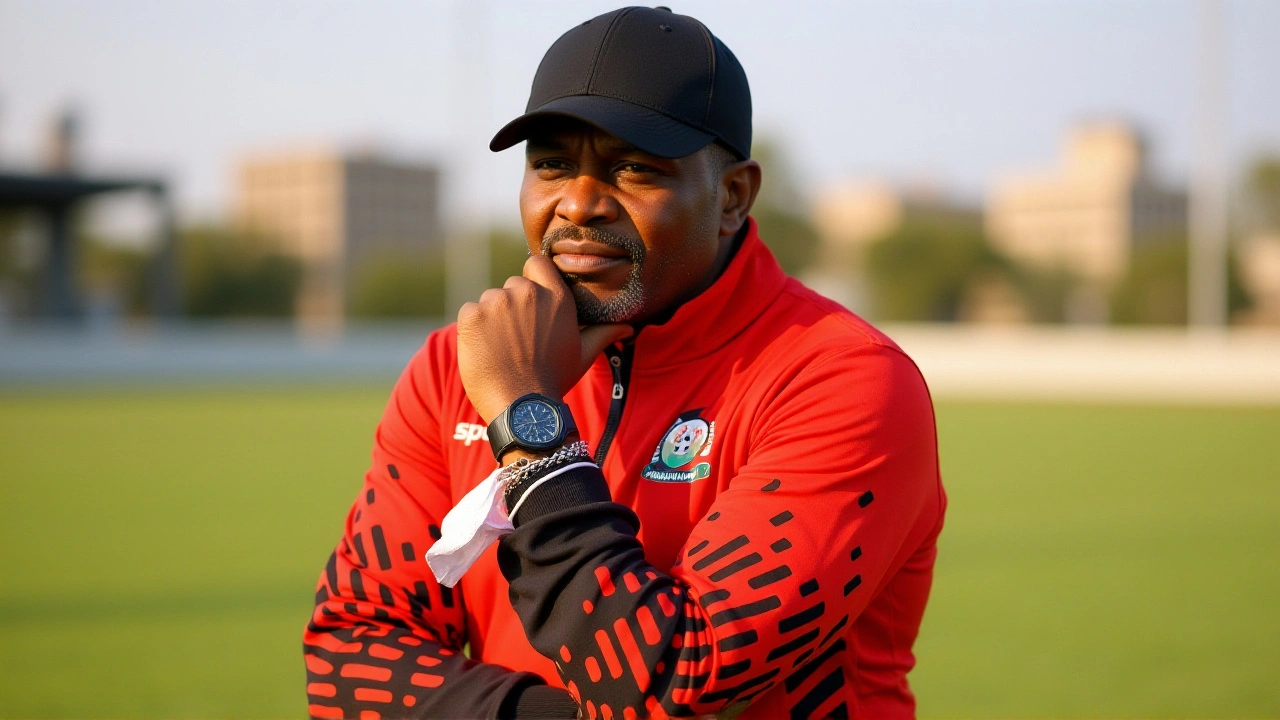
When Jacob Mulee, former coach of the Harambee Stars called out the progress of South Sudan’s football set‑up, the remark resonated far beyond the 1‑1 stalemate that unfolded in Kampala.
The draw came at Nelson Mandela Stadium, a neutral venue on the outskirts of Kampala, Uganda, during the first leg of the 2025 African Nations Championship (CHAN) qualifiers scheduled for October 25‑27, 2024. Kenya’s Harambee Stars faced South Sudan’s Bright Stars, and while neither side walked away with three points, the match gave a clear signal that the young nation is no longer a mere afterthought in East African football.
Background to the CHAN Qualifiers
The Confederation of African Football (CAF) drew the Zone A qualifiers in Cairo on June 13, 2024, pitting Kenya against South Sudan in a two‑leg showdown. Unlike the Africa Cup of Nations, CHAN features only players who ply their trade in domestic leagues, turning the competition into a showcase for home‑grown talent. Kenya, gearing up for its debut at the tournament slated for August 2‑30, 2025, entered the tie under the stewardship of South African tactician Benni McCarthy, while South Sudan continued its post‑independence football building‑block programme overseen by the South Sudan Football Association (SSFA) in Juba.
The 1‑1 Draw in Kampala
The match itself was a tale of two halves. Kenya opened the scoring through a slick wing‑play move involving Mohammed Bajaber, whose burst down the left flank forced a defensive lapse. South Sudan’s equaliser arrived minutes later via a set‑piece header from their captain, a moment that sparked the first genuine applause for the Bright Stars in a CHAN setting.
Beyond the numbers, the atmosphere was electric. Fans from both countries, many travelling overland, sang in Swahili and Arabic, turning the stadium into a cultural bridge. The game ended without the dramatic winning goal, but the post‑match press conference gave it a larger storyline.
Mulee’s Assessment of South Sudan’s Progress
Speaking to TV47 on October 13, 2024, Jacob Mulee praised the strides South Sudan has made since gaining FIFA membership in 2012. "South Sudan have made great strides," he said, noting that the country's football infrastructure has expanded from a single, poorly‑maintained pitch in Juba to a network of regional academies feeding the national team.
Mulee added that the Bright Stars’ tactical discipline, especially in set‑piece organization, was a testament to the SSFA’s recent coaching clinics run in partnership with the German Football Association. "They are no longer an under‑dog in every fixture; they are a team that can hold its own," he remarked.
Implications for Kenya’s CHAN Campaign
For the Harambee Stars, the draw is a mixed bag. It preserves a slim chance to advance if they secure a win in the November 1‑3, 2024 return leg at home in Nairobi. Coach Benni McCarthy has already hinted at a tactical switch, looking to blend youthful exuberance with seasoned experience.
During a recent analysis, Mulee defended McCarthy’s squad selection, highlighting players like Austin Odhiambo and Farouk Shikhalo. "We need the combination of the two, we have players who are ready to do the job and those with experience," Mulee explained, echoing the coach’s own sentiment that depth will be vital against the forthcoming Rwanda‑Djibouti winner.
Beyond tactics, Mulee issued a passionate plea to Kenyan fans: "Come in large numbers. When you hear the roar, the players feel that extra spark." He recalled the 2022 World Cup qualifier against Gabon, where a packed Kenyatta Stadium pushed the side to a late‑game scrabble for a point.
Women’s Teams Parallel Success
While the men’s teams battle for CHAN glory, Kenya’s women’s side, the Harambee Starlets, have been carving their own path. On June 17, 2025, they thumped South Sudan’s women 4‑0 at the Azam Sports Complex in Dar es Salaam during the CECAFA Senior Women’s Challenge Cup. Goals from Faith Mboya, Violet Nanjala, Martha Amunyolet and Elizabeth Ochaka sealed Kenya's second‑place finish with nine points, just a goal behind Tanzania.
The women’s triumph underscores a broader development trend within Kenyan football, driven by the Football Kenya Federation (FKF). Recent investments in youth leagues and coaching certifications have yielded tangible results across both genders.
What’s Next for Both Nations?
If Kenya clinches victory in the November return leg, they will face the Rwanda‑Djibouti winner in the second round, scheduled for December 20‑29, 2024. A win there would place them among the final eight teams advancing to the CHAN finals in East Africa next August.
South Sudan, meanwhile, will use the experience gained from the Kampala draw to fine‑tune its tactics ahead of the next CECAFA edition and future World Cup qualifiers. The SSFA’s long‑term plan, unveiled in a Juba press release in March 2024, aims to establish three regional academies by 2027, a move that could transform the country’s talent pipeline.
In essence, the 1‑1 result is more than a scoreline; it’s a marker of how quickly a nation can evolve when football is treated as a vehicle for national pride.
Frequently Asked Questions
How does the draw affect Kenya’s chances of reaching the 2025 CHAN finals?
The 1‑1 result leaves Kenya level on aggregate, meaning a win in the November second leg at home is essential. A victory would send them to a December knockout against the Rwanda‑Djibouti winner, bringing them one step closer to the August 2025 finals.
What specific progress has South Sudan made in its football development?
Since joining FIFA in 2012, South Sudan has built multiple training facilities, launched youth academies in Juba and Malakal, and partnered with European federations for coaching courses. The tighter defensive shape shown in the Kampala match reflects these structural improvements.
Who are the key players Kenya can rely on for the upcoming qualifier?
Coach Benni McCarthy has highlighted winger Mohammed Bajaber, midfielder Austin Odhiambo, and experienced forward Farouk Shikhalo as the core trio expected to deliver both creativity and stability.
What impact does fan support have on Kenya’s national teams?
Former coach Jacob Mulee noted that large, vocal crowds have historically boosted player morale, citing the 2022 Gabon World Cup qualifier as a turning point. The federation hopes to replicate that energy in upcoming home fixtures.
When and where will the next women's match between Kenya and South Sudan take place?
The women's teams are slated to meet again in the CECAFA Senior Women’s Challenge Cup semifinals on August 5, 2025, with the venue set for the Kigali Stadium in Rwanda.
Thirupathi Reddy Ch
October 13, 2025 AT 23:17It’s obvious that the powers that be are using the South Sudan story as a smokescreen to distract from deeper corruption within CAF, and anyone who buys the feel‑good narrative is complicit. The media loves a ‘rising nation’ angle because it masks the reality that resources are being siphoned for personal gain. Don’t be fooled by the publicity stunt of a 1‑1 draw; look at the funding trails and you’ll see the same old money games. We must remain vigilant and demand total transparency from every federation involved. Only then can we claim genuine progress.
Sonia Arora
October 14, 2025 AT 02:20What a beautiful tapestry of cultures on display! The chants in Swahili and Arabic echoing through Mandela Stadium felt like a celebration of East African unity. South Sudan’s bright stars shining alongside the Harambee Stars shows how sport can bridge borders and histories. It fills my heart to witness such solidarity, and I hope the fans keep the momentum alive when the teams meet again. Here’s to many more moments where football writes a shared story for the region.
Rani Muker
October 14, 2025 AT 05:24For those looking for concrete evidence of development, South Sudan has opened academies in Juba, Malakal, and Aweil since 2018. These centers have produced dozens of players who now feature in domestic league squads and even a few abroad. The partnership with the German FA has also introduced modern coaching curricula, which is reflected in the disciplined set‑piece defending we saw. Kenya could learn from this structured approach, especially at the grassroots level. The data from the last three years shows a steady increase in registered youth players, which bodes well for future national teams.
Hansraj Surti
October 14, 2025 AT 08:27Every time a new chapter of African football is written we witness the subtle alchemy of ambition and heritage merging into something almost ethereal. The match in Kampala was not merely a draw but a convergence of histories unspooling like ancient scrolls rolled anew. South Sudan’s tactical discipline is a testament to the quiet labor of countless coaches laboring in shadows, their whispers shaping a nation’s dream. Kenya, with its storied past, now faces a mirror reflecting its own aspirations and insecurities, a duel of spirits as much as of feet on grass. The fans’ chants rose like a chorus of ancestors, reminding each player of the weight of lineage carried in every stride. In the quiet moments before kickoff, one could almost hear the heartbeat of the continent, steady and relentless. The penalty box became a crucible where pressure forged resilience, each header a small echo of destiny. As the final whistle blew, the scoreboard did not tell the whole tale; the air itself was saturated with promise and unresolved tension. The German partnership, mentioned by Mulee, is more than a technical alliance; it is a cultural conduit, a bridge over a river that has long divided north and south. The discipline seen in set‑pieces is not merely practice, it is a language spoken fluently now by a once‑silent nation. Coaches like Benni McCarthy must contemplate the philosophical underpinnings of strategy, for football is a mirror of society’s order. The draw, a modest result, speaks volumes about the shifting balance of power on the African stage. Many will say it was a draw, but we know it was a moment where futures were quietly negotiated, each player a diplomat of hope. The stadium lights flickered like distant stars, each beam illuminating pathways for the next generation to walk. In the end, the 1‑1 scoreline is a stanza in a larger poem, one that will be recited for years to come 😊.
Naman Patidar
October 14, 2025 AT 11:30Just another draw, nothing special.
Vinay Bhushan
October 14, 2025 AT 14:34Every match, even a draw, is a chance to build belief. The players showed resilience and with the right support they can turn this into a win. Keep the energy high, the fans will feel it.
Parth Kaushal
October 14, 2025 AT 17:37The grandeur of that long‑winded analysis by Hansraj cannot be overstated. He weaves together history, philosophy, and the very essence of football into a tapestry that demands our full attention. While some may dismiss the verbosity, I find it elevates the conversation beyond mere statistics. His reference to the "ancient scrolls" and the "heartbeat of the continent" paints a picture that resonates with anyone who loves the beautiful game. Moreover, his insistence on viewing a 1‑1 scoreline as a "moment where futures were quietly negotiated" forces us to reconsider our metrics of success. In essence, his words remind us that the sport is a living, breathing narrative that reflects societal shifts. As a drama‑loving fan, I appreciate the theatrical flair he brings, and I think it adds depth to the discourse surrounding East African football. Let us embrace his perspective and allow the drama to inspire the next generation of players and supporters alike.
Namrata Verma
October 14, 2025 AT 20:40Wow, another poetic ode to a boring 1‑1 draw-how original!; I can’t help but notice the excessive flourish while the actual game was nothing more than two lads kicking a ball.; If we’re counting emojis as insight, then we’ve all clearly missed the point; the match was a flat, uneventful stalemate that deserves a simple statement, not a novel.;
Manish Mistry
October 14, 2025 AT 23:44Statistically speaking, both teams posted 55% possession and a combined 13 shots on target, indicating a balanced encounter. The defensive errors were minimal, with only two clear chances missed. South Sudan’s passing accuracy at 78% surpasses Kenya’s 74%, suggesting a slight edge in midfield cohesion. However, Kenya’s counter‑attack efficiency was higher, netting the opening goal. Overall, the data supports a fairly even contest, reinforcing the notion that future fixtures will be closely fought.
Tanvi Shrivastav
October 15, 2025 AT 02:47Oh great, another "deep" analysis that reads like a pretentious thesis 😂. The writer clearly spent too much time on Twitter and not enough on the actual game. Numbers? Yeah, they’re there, but they’re as boring as a rainy Tuesday. Maybe next time we’ll get a comment that actually says something useful? 🙄
Veda t
October 15, 2025 AT 05:50The Kenyan fans should dominate the stadium, showing true patriotism and overwhelming the opposition.